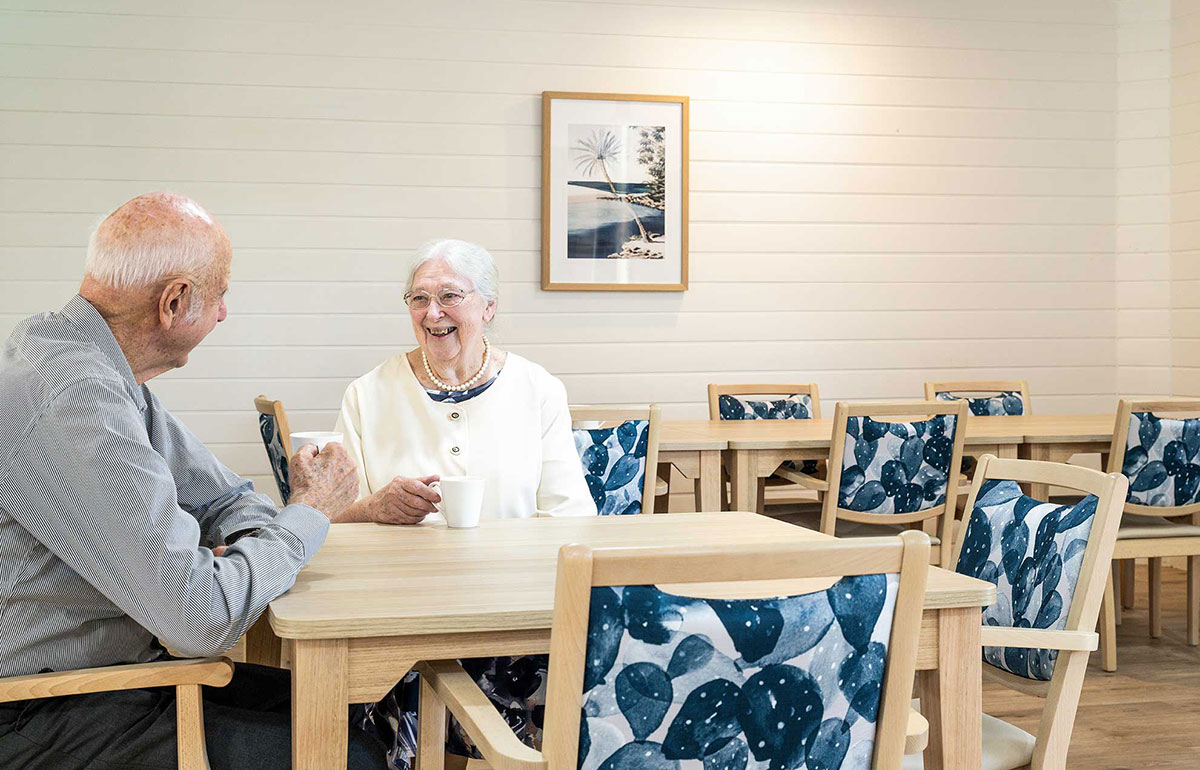
Before You Replace Those Dining Chairs, Ask These 7 Questions
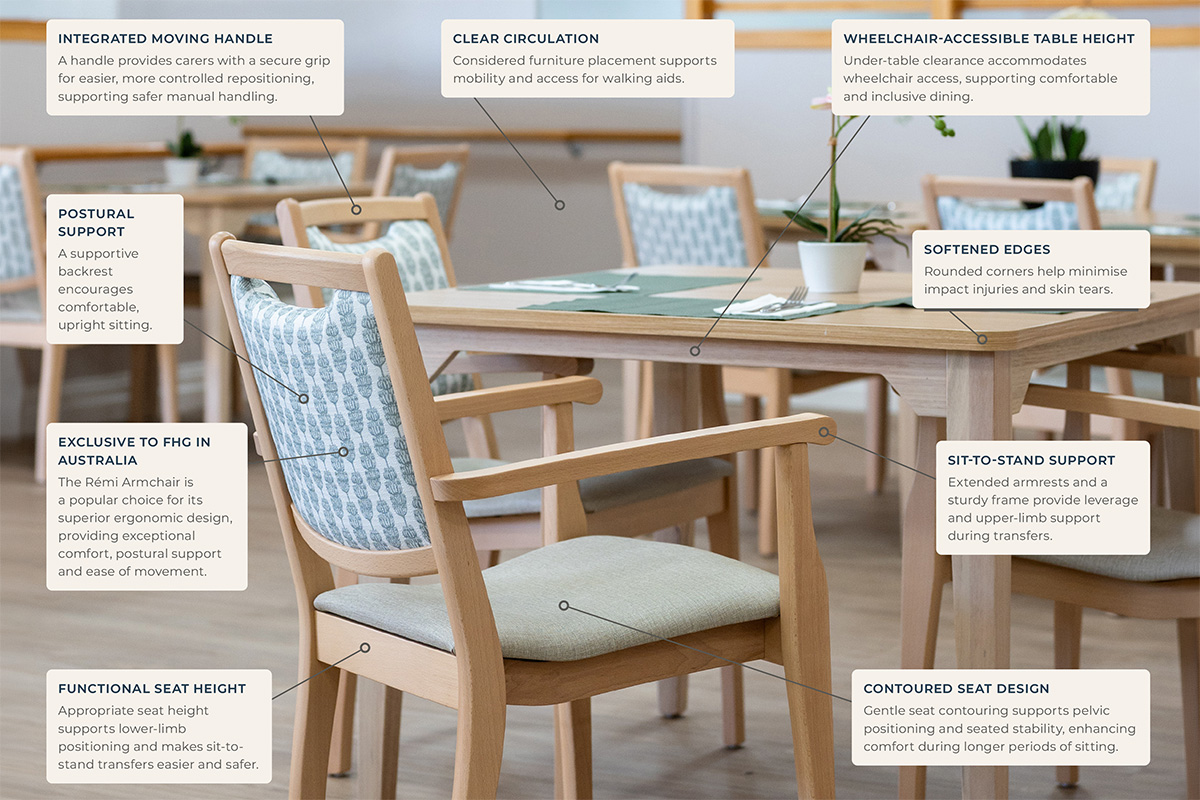
Replacing dining chairs in an aged care facility or retirement village?
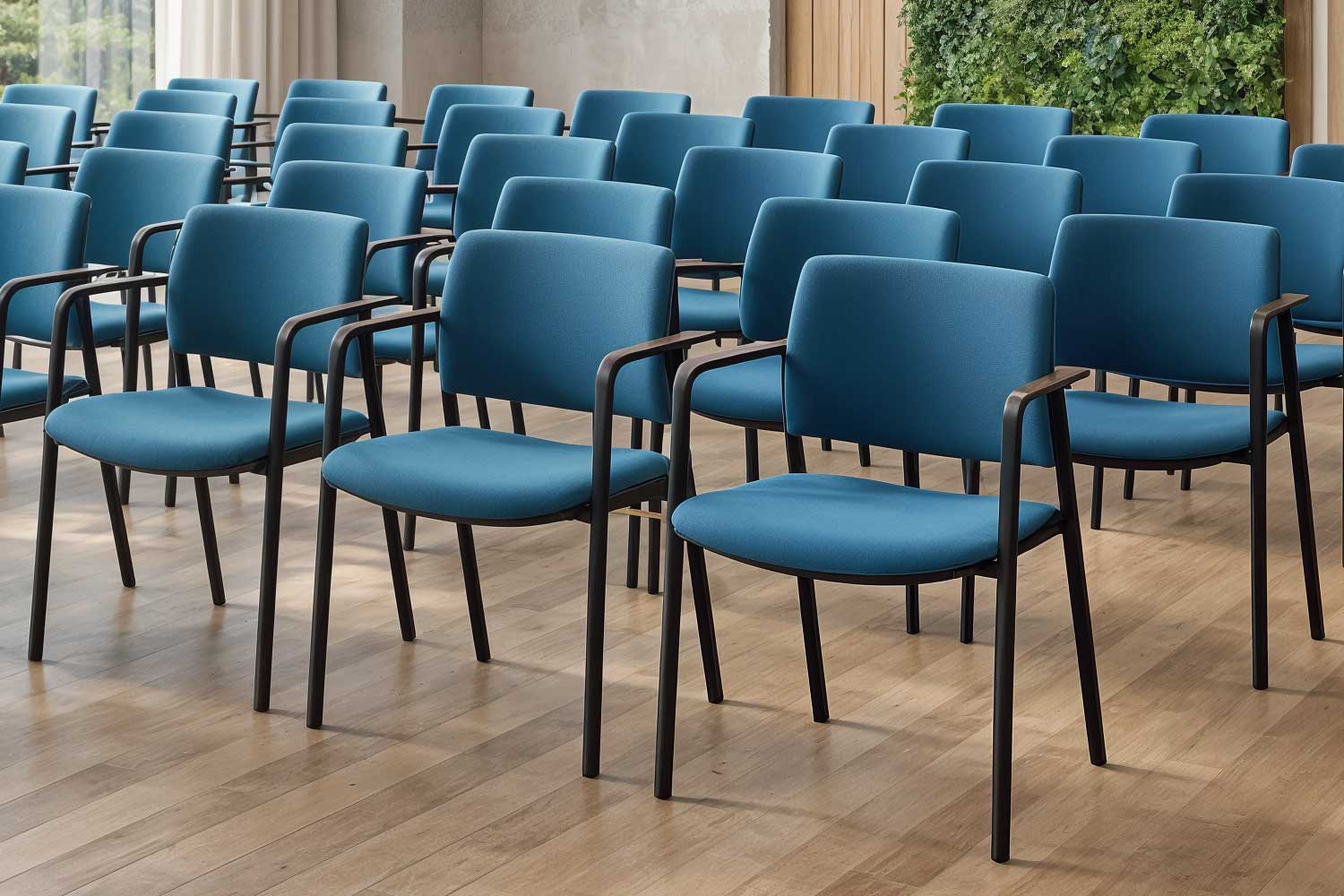
Before comparing styles, fabrics and prices, there are seven important questions worth asking.
Dining chairs are among the hardest-working pieces of furniture in any residential aged care home. They’re used several times a day, moved around, cleaned regularly and expected to accommodate residents with very different physical needs.
Yet it’s surprisingly easy to focus on how a chair looks, what it costs and whether it matches the existing décor, while overlooking details that can make a significant difference to everyday use.
A chair that looks beautiful in a showroom might be too low for some residents to stand from comfortably. An upholstered seat might be easy to wipe down but allow moisture to reach the foam through its seams. And a low-cost chair might become an expensive purchase if it needs replacing after only a few years.
Whether you’re replacing 20 dining chairs or specifying furniture for an entire facility, the right questions at the beginning can help you avoid costly mistakes later.
At a Glance: What to Look for in Aged Care Dining Chairs
When selecting dining chairs for residential aged care, prioritise:
- Seat height and depth: Appropriate for residents’ mobility, posture and transfer requirements.
- Supportive armrests: Stable, accessible and compatible with the dining tables.
- Structural durability: Commercial-grade construction suited to frequent use.
- Cleanable upholstery: Materials and construction compatible with the facility’s cleaning procedures.
- Manoeuvrability: Chairs that staff can reposition safely without compromising stability.
- Residential appearance: Comfortable, welcoming designs that reflect resident preferences.
- Whole-of-life value: Consider warranties, repairs, reupholstery and replacement costs alongside purchase price.
These are the seven areas worth investigating before placing an order.
1. Is the Seat Height Right for Your Residents?
Seat height is one of the most important considerations when selecting aged care dining chairs.
A chair that’s too low can make standing more difficult, particularly for residents with reduced lower-limb strength or mobility limitations. A chair that’s too high may leave someone’s feet unsupported, affecting comfort and stability.
What seat height should an aged care dining chair have?
As an initial specification reference, seat heights of approximately 470–520 mm may be worth evaluating for some aged care applications. This is an indicative range, not an Australian regulatory requirement or a dimension suitable for every resident.
The appropriate height depends on the individual, their footwear, posture, mobility and transfer needs. Cushion compression also matters: a chair’s unloaded seat height may differ from its height when occupied.
Practical tips
- Measure existing chairs that residents find comfortable and easy to use.
- Ask care staff whether residents regularly struggle to stand from particular chairs.
- Consider whether residents can place their feet securely on the floor.
- Check the seat height under load, especially with softer upholstered cushions.
- Consult an occupational therapist when selecting furniture for residents with specific mobility requirements.
Before ordering: Arrange a physical chair sample and test it with representative users, with appropriate clinical support.
A few minutes spent assessing a chair in the actual dining environment can reveal issues that aren’t obvious from a product photograph or specification sheet.
2. Do the Armrests Provide the Right Support?
Armrests aren’t simply a design feature. For many residents, they are an important point of support when sitting down, repositioning or standing up.
But not all armrests are equally useful.
Some are too short to provide effective support. Others are too low, too narrow or shaped in ways that make them difficult to grip.
What makes a good aged care dining chair armrest?
Look for armrests that are:
- Stable: Firmly connected to the chair’s structure.
- Accessible: Positioned where residents can comfortably reach them.
- Supportive: Suitable for the intended sitting and standing movements.
- Comfortable: Shaped to avoid unnecessary pressure on the forearms.
- Compatible with tables: Able to fit appropriately beneath or alongside the dining table.
Armrest height is sometimes considered within an indicative range of approximately 630–680 mm from the floor, but this should not be treated as a universal specification. The correct dimensions depend on the chair, table and intended users.
Don’t forget the dining table
One of the most common specification oversights is selecting chairs and tables independently.
A chair may be comfortable on its own but difficult to position close to the table because the armrests collide with the underside of the tabletop or its apron.
Practical tip: Measure the underside clearance of the actual dining tables before selecting chairs. Check armrest height, chair width, table legs and any supporting rails.
Where possible, trial the chair and table together.
3. Will the Chair Withstand Everyday Commercial Use?
A residential aged care dining chair has a very different working life from a dining chair in a private home.
It may be used for several meals and activities each day, repositioned frequently and exposed to repeated cleaning.
Over time, these demands place considerable stress on frames, joints, upholstery and finishes.
What should you look for in chair construction?
Ask your supplier about:
Frame materials
Solid timber and appropriately engineered metal frames can both offer good performance when correctly designed and manufactured.
Joinery and structural connections
The quality of joints, fixings and frame construction matters as much as the material itself.
Weight capacity
Request the manufacturer’s stated weight capacity and any applicable test information. Where residents require specialised or bariatric seating, ensure the chair is specifically designed and assessed for that purpose.
Surface finishes
Dining chairs are regularly exposed to spills, cleaning agents and physical wear. Ask whether the timber or metal finishes are compatible with the facility’s maintenance procedures.
Warranty
A meaningful structural warranty can provide reassurance, but check what is covered, what is excluded and whether commercial use is included.
Practical tip: Ask for evidence, not just descriptions
Terms such as commercial grade, heavy duty and high quality are useful starting points, but they aren’t substitutes for specifications.
Request construction details, applicable test information, warranty terms and maintenance instructions.
Before ordering: Ask your supplier how the chair has been designed for frequent use in commercial aged care environments.
4. Is the Upholstery Really Suitable for Aged Care?
Dining chair upholstery has a demanding job.
It needs to feel comfortable, complement the interior and withstand spills, frequent cleaning and everyday wear.
But selecting a fabric based on colour and abrasion resistance alone can leave important questions unanswered.
What upholstery features matter most?
Cleanability
Can the fabric be cleaned using the products and procedures approved by your facility?
Moisture resistance
Does the upholstery offer an appropriate moisture barrier, and how are seams, joins and other potential entry points managed?
Durability
Is the fabric suitable for high-use commercial seating? Ask for relevant abrasion and performance test results, while remembering that abrasion ratings alone do not predict the complete lifespan of a chair.
Stain resistance
How readily can common food and beverage spills be removed?
Maintenance
Are there restrictions on cleaning chemicals, disinfectants or methods that could affect the fabric’s performance?
Why fabric construction matters
A fabric may perform well in isolation, but the finished chair also needs to be considered.
Seams, piping, stitching, cushion construction and the materials beneath the upholstery can influence cleanability and moisture management.
For example, a moisture-resistant textile does not automatically mean that every part of the upholstered chair is waterproof.
What about performance fabrics such as Crypton?
Suitable Crypton performance fabrics can offer useful stain resistance and moisture protection, making them worth considering for demanding commercial interiors.
However, specifications vary between products. Confirm the selected fabric’s actual performance characteristics, cleaning instructions and suitability for the intended application.
Practical tip: Request a physical fabric sample and the manufacturer’s cleaning documentation before approving the final specification.
Where appropriate, assess how the material responds to the facility’s approved cleaning methods.
The goal isn’t simply to find upholstery that looks good when new. It’s to select materials that remain practical and presentable throughout everyday use.
5. Can Staff Move and Manage the Chairs Easily?
A dining chair needs to work for residents, but it also needs to be practical for the people maintaining and arranging the dining space.
Chairs may be repositioned to accommodate wheelchairs, mobility aids, cleaning equipment, group activities and changing seating arrangements.
A chair that’s unnecessarily heavy or awkward to handle can make these tasks more difficult.
On the other hand, a chair that’s excessively lightweight or unstable may be unsuitable for residents who rely on it for support.
What should you consider?
- Can staff reposition the chair without excessive effort?
- Is the chair stable during normal sitting and standing movements?
- Are there suitable points for handling the chair?
- Does the design allow easy access beneath and around the seat for cleaning?
- Are the legs and feet appropriate for the flooring?
- Can the chair be moved without damaging floors or creating unnecessary noise?
A practical test worth doing
Ask a staff member to move the sample chair into and away from the dining table, reposition it for cleaning and return it to its usual location.
Observe whether the task is comfortable and manageable.
Also consider the flooring. Chair feet that work well on carpet may behave differently on vinyl, timber-look flooring or tiles.
Before ordering: Test the chair on the same flooring type used in your facility, where practical.
Small operational details can have a significant effect when repeated across dozens of chairs, several times a day.
6. Will the Chairs Help Create a Dining Room That Feels Like Home?
Aged care dining rooms aren’t simply places where meals are served.
They’re spaces where residents gather, socialise, celebrate birthdays, welcome visitors and participate in everyday community life.
Furniture contributes to how those spaces feel.
While safety, accessibility and durability are essential, they shouldn’t come at the expense of comfort, character or personal choice.
How can dining chairs contribute to a more welcoming environment?
Choose residential-style designs
Timber finishes, thoughtfully selected upholstery and familiar chair shapes can help create a warmer, less institutional atmosphere.
Consider colour and contrast
Sufficient contrast between chairs, tables and flooring can make furniture easier to distinguish for some residents with visual or cognitive changes.
Offer appropriate seating choices
Different residents may benefit from different chair dimensions, support levels or cushioning. A consistent interior doesn’t necessarily require every chair to be identical.
Think about the whole room
Dining chairs should work with tables, lighting, flooring, circulation space and the overall interior design.
Involve residents
Where possible, seek residents’ views on comfort, appearance and preferences. A chair that meets technical requirements but is disliked by the people using it may not be the best choice.
What about residents living with dementia?
Familiarity, visual clarity, comfortable seating and uncomplicated layouts can help create supportive dining environments.
Avoid assuming that a single colour palette, pattern or chair design will suit every person living with dementia.
Practical tip: When trialling sample chairs, gather feedback from residents as well as care, lifestyle and cleaning staff.
The most useful furniture decisions consider both the people who use the chairs and those who care for the environment.
7. Are You Comparing the Purchase Price or the Real Cost?
When budgets are tight, it’s understandable to focus on the unit price.
But the cheapest dining chair isn’t necessarily the most economical choice over time.
A lower-priced chair may cost more in the long run if it needs frequent repairs, reupholstery or early replacement.
What is the total cost of ownership of a dining chair?
Total cost of ownership considers the initial purchase price together with the costs of maintenance, repairs, refurbishment and replacement over the chair’s useful life.
For example, consider two hypothetical purchasing options:
| Chair A | Chair B | |
|---|---|---|
| Purchase price | $250 | $400 |
| Quantity | 100 | 100 |
| Initial investment | $25,000 | $40,000 |
| Assumed service life | 5 years | 10 years |
| Annualised purchase cost | $5,000 | $4,000 |
In this simplified example, Chair B has a higher initial cost but a lower annualised purchase cost over its assumed service life.
These figures are illustrative only, not FHG product prices or predicted lifespans. Actual value depends on usage, maintenance, repair costs, warranty coverage and how long each chair remains fit for purpose.
Questions to ask about long-term value
- Can the chair be reupholstered rather than replaced?
- Are replacement components available?
- What does the structural warranty cover?
- Can the manufacturer provide after-sales support?
- Is the chair likely to remain suitable as resident needs change?
- What are the expected maintenance requirements?
- Can future orders match the existing furniture if additional chairs are needed?
Why local manufacturing can be an advantage
Australian manufacturing may offer practical benefits for facilities seeking custom dimensions, particular finishes, replacement components or ongoing supplier support.
At FHG Furniture, our Brisbane manufacturing capability allows us to work with clients on custom furniture solutions suited to their project requirements.
The important consideration isn’t simply where a chair is made, but whether the supplier can deliver the quality, suitability, consistency and support your facility needs.
Before ordering: Compare supplier proposals on whole-of-life value, not unit price alone.
Aged Care Dining Chair Specification Checklist
Use this checklist when comparing products or requesting quotations.
| Specification | What to confirm |
|---|---|
| Seat height | Measured height, including cushion compression where relevant |
| Seat depth and width | Suitability for intended residents |
| Armrests | Height, stability, shape and table compatibility |
| Frame | Construction materials, joints and structural integrity |
| Weight capacity | Manufacturer’s stated capacity and supporting information |
| Upholstery | Durability, cleanability, moisture performance and care instructions |
| Finishes | Compatibility with cleaning procedures and everyday wear |
| Chair handling | Weight, stability and ease of repositioning |
| Accessibility | Suitability alongside tables, wheelchairs and circulation requirements |
| Warranty | Structural coverage, exclusions and after-sales support |
| Repairability | Availability of reupholstery, repairs and replacement components |
| Design | Comfort, appearance, resident choice and compatibility with the interior |
Supplier tip: Ask each shortlisted manufacturer to complete the same specification checklist. This makes it easier to compare products on relevant performance criteria rather than price and appearance alone.
Should You Trial Dining Chairs Before Placing a Large Order?
Where practical, yes.
A physical sample provides an opportunity to assess aspects of furniture suitability that can be difficult to judge from drawings, catalogues or online product listings.
A useful chair trial should involve representatives from the groups who will use or manage the furniture.
A simple five-step trial
- Measure: Check the sample chair against your dining tables and required dimensions.
- Test comfort: Gather feedback from representative residents, with clinical input where appropriate.
- Check transfers: Assess sitting and standing suitability for intended users without undertaking unsafe or unsupported transfer trials.
- Review maintenance: Ask cleaning staff to assess the materials and construction against approved procedures.
- Record feedback: Document what works, what doesn’t and any changes required before final approval.
For larger projects, request confirmation that the final production specification will match the approved sample, including dimensions, upholstery, finishes and construction.
A successful sample trial is not a substitute for individual seating assessments where these are required.
How Do the Strengthened Aged Care Quality Standards Relate to Dining Furniture?
Australia’s strengthened Aged Care Quality Standards commenced on 1 November 2025.
Standard 4: The Environment is particularly relevant when reviewing dining furniture. It addresses safe, comfortable, accessible and well-maintained environments, along with equipment that is safe and meets people’s needs.
Furniture selection can contribute to these outcomes through appropriate seating, accessible layouts, suitable materials and effective maintenance.
The Standards apply to relevant aged care providers. They do not establish a single universal seat height, fabric specification or certification that automatically makes a dining chair compliant.
For detailed guidance, refer to the Aged Care Quality and Safety Commission.
The Right Dining Chair Is About More Than Sitting Comfortably
Replacing dining chairs may seem like a relatively straightforward purchasing decision.
But when those chairs are used every day by people with different mobility, comfort and care requirements, the details matter.
The right choice should work for residents, staff, maintenance teams and the facility’s long-term budget.
Before you place your next order, take the time to assess dimensions, support, construction, upholstery, handling, design and whole-of-life value.
A well-considered specification today can help you avoid unnecessary compromises tomorrow.
Need Help Specifying Dining Chairs for Your Facility?
At FHG Furniture, we work with aged care providers, retirement living operators, procurement teams and interior designers to develop practical, purpose-built furniture solutions.
With Australian manufacturing capabilities in Brisbane, we can help explore appropriate dimensions, upholstery, finishes and design options for your project.
Whether you’re replacing existing dining chairs or planning a complete refurbishment, our Project Consultants can help you work through the details.
Talk to an FHG Project Consultant
Frequently Asked Questions
What is the best seat height for aged care dining chairs?
There is no single ideal seat height for all aged care residents. Heights around 470–520 mm may be considered as an initial reference for some applications, but individual mobility, posture, leg length and transfer requirements determine suitability. An occupational therapist can assist where individual seating needs require assessment.
Should aged care dining chairs have armrests?
Supportive armrests are often beneficial because they can provide stability during sitting and standing. However, their height, shape and construction must suit the intended user. Armrests should also be checked for compatibility with the dining tables.
What is the best upholstery for aged care dining chairs?
The most suitable upholstery depends on the facility’s cleaning procedures, expected usage, moisture protection requirements, comfort preferences and design objectives. Commercial performance fabrics with appropriate cleaning and durability characteristics are commonly considered, but the complete upholstered chair construction should also be assessed.
Are timber dining chairs suitable for aged care facilities?
Yes. Well-designed timber dining chairs can be suitable for commercial aged care environments when their construction, stability, finish, maintenance requirements and weight capacity are appropriate for the intended use. The quality of the complete chair matters more than the frame material alone.
How long should commercial aged care dining chairs last?
There is no universal service life. Longevity depends on construction quality, frequency of use, maintenance, cleaning methods and changing resident requirements. Procurement teams should consider repairability, warranty coverage and lifecycle costs rather than relying on an assumed replacement interval.
Is Australian-made furniture better for aged care?
Australian manufacturing can offer advantages such as local communication, customisation, production oversight and access to after-sales support. However, suitability should be assessed against the actual product specification, performance evidence, warranty and supplier capability rather than country of manufacture alone.
What should procurement managers request before ordering dining chairs?
Request detailed dimensions, weight capacity, construction information, upholstery specifications, cleaning instructions, warranty terms, applicable test information, delivery details and any customisation options. For larger orders, a physical sample and documented approval process are advisable.
Fit for Purpose Aged Care Furniture
Recent Updates
Before You Replace Those Dining Chairs, Ask These 7 Questions
Replacing dining chairs in an aged care facility or retirement village?
Before comparing styles, fabrics and prices, there are seven important questions worth asking.
Dining chairs are among the hardest-working pieces of furniture in any residential aged care home. They’re used several times a day, moved around, cleaned regularly and expected to accommodate residents with very different physical needs.
Yet it’s surprisingly easy to focus on how a chair looks, what it costs and whether it matches the existing décor, while overlooking details that can make a significant difference to everyday use.
A chair that looks beautiful in a showroom might be too low for some residents to stand from comfortably. An upholstered seat might be easy to wipe down but allow moisture to reach the foam through its seams. And a low-cost chair might become an expensive purchase if it needs replacing after only a few years.
Whether you’re replacing 20 dining chairs or specifying furniture for an entire facility, the right questions at the beginning can help you avoid costly mistakes later.
At a Glance: What to Look for in Aged Care Dining Chairs
When selecting dining chairs for residential aged care, prioritise:
- Seat height and depth: Appropriate for residents’ mobility, posture and transfer requirements.
- Supportive armrests: Stable, accessible and compatible with the dining tables.
- Structural durability: Commercial-grade construction suited to frequent use.
- Cleanable upholstery: Materials and construction compatible with the facility’s cleaning procedures.
- Manoeuvrability: Chairs that staff can reposition safely without compromising stability.
- Residential appearance: Comfortable, welcoming designs that reflect resident preferences.
- Whole-of-life value: Consider warranties, repairs, reupholstery and replacement costs alongside purchase price.
These are the seven areas worth investigating before placing an order.
1. Is the Seat Height Right for Your Residents?
Seat height is one of the most important considerations when selecting aged care dining chairs.
A chair that’s too low can make standing more difficult, particularly for residents with reduced lower-limb strength or mobility limitations. A chair that’s too high may leave someone’s feet unsupported, affecting comfort and stability.
What seat height should an aged care dining chair have?
As an initial specification reference, seat heights of approximately 470–520 mm may be worth evaluating for some aged care applications. This is an indicative range, not an Australian regulatory requirement or a dimension suitable for every resident.
The appropriate height depends on the individual, their footwear, posture, mobility and transfer needs. Cushion compression also matters: a chair’s unloaded seat height may differ from its height when occupied.
Practical tips
- Measure existing chairs that residents find comfortable and easy to use.
- Ask care staff whether residents regularly struggle to stand from particular chairs.
- Consider whether residents can place their feet securely on the floor.
- Check the seat height under load, especially with softer upholstered cushions.
- Consult an occupational therapist when selecting furniture for residents with specific mobility requirements.
Before ordering: Arrange a physical chair sample and test it with representative users, with appropriate clinical support.
A few minutes spent assessing a chair in the actual dining environment can reveal issues that aren’t obvious from a product photograph or specification sheet.
2. Do the Armrests Provide the Right Support?
Armrests aren’t simply a design feature. For many residents, they are an important point of support when sitting down, repositioning or standing up.
But not all armrests are equally useful.
Some are too short to provide effective support. Others are too low, too narrow or shaped in ways that make them difficult to grip.
What makes a good aged care dining chair armrest?
Look for armrests that are:
- Stable: Firmly connected to the chair’s structure.
- Accessible: Positioned where residents can comfortably reach them.
- Supportive: Suitable for the intended sitting and standing movements.
- Comfortable: Shaped to avoid unnecessary pressure on the forearms.
- Compatible with tables: Able to fit appropriately beneath or alongside the dining table.
Armrest height is sometimes considered within an indicative range of approximately 630–680 mm from the floor, but this should not be treated as a universal specification. The correct dimensions depend on the chair, table and intended users.
Don’t forget the dining table
One of the most common specification oversights is selecting chairs and tables independently.
A chair may be comfortable on its own but difficult to position close to the table because the armrests collide with the underside of the tabletop or its apron.
Practical tip: Measure the underside clearance of the actual dining tables before selecting chairs. Check armrest height, chair width, table legs and any supporting rails.
Where possible, trial the chair and table together.
3. Will the Chair Withstand Everyday Commercial Use?
A residential aged care dining chair has a very different working life from a dining chair in a private home.
It may be used for several meals and activities each day, repositioned frequently and exposed to repeated cleaning.
Over time, these demands place considerable stress on frames, joints, upholstery and finishes.
What should you look for in chair construction?
Ask your supplier about:
Frame materials
Solid timber and appropriately engineered metal frames can both offer good performance when correctly designed and manufactured.
Joinery and structural connections
The quality of joints, fixings and frame construction matters as much as the material itself.
Weight capacity
Request the manufacturer’s stated weight capacity and any applicable test information. Where residents require specialised or bariatric seating, ensure the chair is specifically designed and assessed for that purpose.
Surface finishes
Dining chairs are regularly exposed to spills, cleaning agents and physical wear. Ask whether the timber or metal finishes are compatible with the facility’s maintenance procedures.
Warranty
A meaningful structural warranty can provide reassurance, but check what is covered, what is excluded and whether commercial use is included.
Practical tip: Ask for evidence, not just descriptions
Terms such as commercial grade, heavy duty and high quality are useful starting points, but they aren’t substitutes for specifications.
Request construction details, applicable test information, warranty terms and maintenance instructions.
Before ordering: Ask your supplier how the chair has been designed for frequent use in commercial aged care environments.
4. Is the Upholstery Really Suitable for Aged Care?
Dining chair upholstery has a demanding job.
It needs to feel comfortable, complement the interior and withstand spills, frequent cleaning and everyday wear.
But selecting a fabric based on colour and abrasion resistance alone can leave important questions unanswered.
What upholstery features matter most?
Cleanability
Can the fabric be cleaned using the products and procedures approved by your facility?
Moisture resistance
Does the upholstery offer an appropriate moisture barrier, and how are seams, joins and other potential entry points managed?
Durability
Is the fabric suitable for high-use commercial seating? Ask for relevant abrasion and performance test results, while remembering that abrasion ratings alone do not predict the complete lifespan of a chair.
Stain resistance
How readily can common food and beverage spills be removed?
Maintenance
Are there restrictions on cleaning chemicals, disinfectants or methods that could affect the fabric’s performance?
Why fabric construction matters
A fabric may perform well in isolation, but the finished chair also needs to be considered.
Seams, piping, stitching, cushion construction and the materials beneath the upholstery can influence cleanability and moisture management.
For example, a moisture-resistant textile does not automatically mean that every part of the upholstered chair is waterproof.
What about performance fabrics such as Crypton?
Suitable Crypton performance fabrics can offer useful stain resistance and moisture protection, making them worth considering for demanding commercial interiors.
However, specifications vary between products. Confirm the selected fabric’s actual performance characteristics, cleaning instructions and suitability for the intended application.
Practical tip: Request a physical fabric sample and the manufacturer’s cleaning documentation before approving the final specification.
Where appropriate, assess how the material responds to the facility’s approved cleaning methods.
The goal isn’t simply to find upholstery that looks good when new. It’s to select materials that remain practical and presentable throughout everyday use.
5. Can Staff Move and Manage the Chairs Easily?
A dining chair needs to work for residents, but it also needs to be practical for the people maintaining and arranging the dining space.
Chairs may be repositioned to accommodate wheelchairs, mobility aids, cleaning equipment, group activities and changing seating arrangements.
A chair that’s unnecessarily heavy or awkward to handle can make these tasks more difficult.
On the other hand, a chair that’s excessively lightweight or unstable may be unsuitable for residents who rely on it for support.
What should you consider?
- Can staff reposition the chair without excessive effort?
- Is the chair stable during normal sitting and standing movements?
- Are there suitable points for handling the chair?
- Does the design allow easy access beneath and around the seat for cleaning?
- Are the legs and feet appropriate for the flooring?
- Can the chair be moved without damaging floors or creating unnecessary noise?
A practical test worth doing
Ask a staff member to move the sample chair into and away from the dining table, reposition it for cleaning and return it to its usual location.
Observe whether the task is comfortable and manageable.
Also consider the flooring. Chair feet that work well on carpet may behave differently on vinyl, timber-look flooring or tiles.
Before ordering: Test the chair on the same flooring type used in your facility, where practical.
Small operational details can have a significant effect when repeated across dozens of chairs, several times a day.
6. Will the Chairs Help Create a Dining Room That Feels Like Home?
Aged care dining rooms aren’t simply places where meals are served.
They’re spaces where residents gather, socialise, celebrate birthdays, welcome visitors and participate in everyday community life.
Furniture contributes to how those spaces feel.
While safety, accessibility and durability are essential, they shouldn’t come at the expense of comfort, character or personal choice.
How can dining chairs contribute to a more welcoming environment?
Choose residential-style designs
Timber finishes, thoughtfully selected upholstery and familiar chair shapes can help create a warmer, less institutional atmosphere.
Consider colour and contrast
Sufficient contrast between chairs, tables and flooring can make furniture easier to distinguish for some residents with visual or cognitive changes.
Offer appropriate seating choices
Different residents may benefit from different chair dimensions, support levels or cushioning. A consistent interior doesn’t necessarily require every chair to be identical.
Think about the whole room
Dining chairs should work with tables, lighting, flooring, circulation space and the overall interior design.
Involve residents
Where possible, seek residents’ views on comfort, appearance and preferences. A chair that meets technical requirements but is disliked by the people using it may not be the best choice.
What about residents living with dementia?
Familiarity, visual clarity, comfortable seating and uncomplicated layouts can help create supportive dining environments.
Avoid assuming that a single colour palette, pattern or chair design will suit every person living with dementia.
Practical tip: When trialling sample chairs, gather feedback from residents as well as care, lifestyle and cleaning staff.
The most useful furniture decisions consider both the people who use the chairs and those who care for the environment.
7. Are You Comparing the Purchase Price or the Real Cost?
When budgets are tight, it’s understandable to focus on the unit price.
But the cheapest dining chair isn’t necessarily the most economical choice over time.
A lower-priced chair may cost more in the long run if it needs frequent repairs, reupholstery or early replacement.
What is the total cost of ownership of a dining chair?
Total cost of ownership considers the initial purchase price together with the costs of maintenance, repairs, refurbishment and replacement over the chair’s useful life.
For example, consider two hypothetical purchasing options:
| Chair A | Chair B | |
|---|---|---|
| Purchase price | $250 | $400 |
| Quantity | 100 | 100 |
| Initial investment | $25,000 | $40,000 |
| Assumed service life | 5 years | 10 years |
| Annualised purchase cost | $5,000 | $4,000 |
In this simplified example, Chair B has a higher initial cost but a lower annualised purchase cost over its assumed service life.
These figures are illustrative only, not FHG product prices or predicted lifespans. Actual value depends on usage, maintenance, repair costs, warranty coverage and how long each chair remains fit for purpose.
Questions to ask about long-term value
- Can the chair be reupholstered rather than replaced?
- Are replacement components available?
- What does the structural warranty cover?
- Can the manufacturer provide after-sales support?
- Is the chair likely to remain suitable as resident needs change?
- What are the expected maintenance requirements?
- Can future orders match the existing furniture if additional chairs are needed?
Why local manufacturing can be an advantage
Australian manufacturing may offer practical benefits for facilities seeking custom dimensions, particular finishes, replacement components or ongoing supplier support.
At FHG Furniture, our Brisbane manufacturing capability allows us to work with clients on custom furniture solutions suited to their project requirements.
The important consideration isn’t simply where a chair is made, but whether the supplier can deliver the quality, suitability, consistency and support your facility needs.
Before ordering: Compare supplier proposals on whole-of-life value, not unit price alone.
Aged Care Dining Chair Specification Checklist
Use this checklist when comparing products or requesting quotations.
| Specification | What to confirm |
|---|---|
| Seat height | Measured height, including cushion compression where relevant |
| Seat depth and width | Suitability for intended residents |
| Armrests | Height, stability, shape and table compatibility |
| Frame | Construction materials, joints and structural integrity |
| Weight capacity | Manufacturer’s stated capacity and supporting information |
| Upholstery | Durability, cleanability, moisture performance and care instructions |
| Finishes | Compatibility with cleaning procedures and everyday wear |
| Chair handling | Weight, stability and ease of repositioning |
| Accessibility | Suitability alongside tables, wheelchairs and circulation requirements |
| Warranty | Structural coverage, exclusions and after-sales support |
| Repairability | Availability of reupholstery, repairs and replacement components |
| Design | Comfort, appearance, resident choice and compatibility with the interior |
Supplier tip: Ask each shortlisted manufacturer to complete the same specification checklist. This makes it easier to compare products on relevant performance criteria rather than price and appearance alone.
Should You Trial Dining Chairs Before Placing a Large Order?
Where practical, yes.
A physical sample provides an opportunity to assess aspects of furniture suitability that can be difficult to judge from drawings, catalogues or online product listings.
A useful chair trial should involve representatives from the groups who will use or manage the furniture.
A simple five-step trial
- Measure: Check the sample chair against your dining tables and required dimensions.
- Test comfort: Gather feedback from representative residents, with clinical input where appropriate.
- Check transfers: Assess sitting and standing suitability for intended users without undertaking unsafe or unsupported transfer trials.
- Review maintenance: Ask cleaning staff to assess the materials and construction against approved procedures.
- Record feedback: Document what works, what doesn’t and any changes required before final approval.
For larger projects, request confirmation that the final production specification will match the approved sample, including dimensions, upholstery, finishes and construction.
A successful sample trial is not a substitute for individual seating assessments where these are required.
How Do the Strengthened Aged Care Quality Standards Relate to Dining Furniture?
Australia’s strengthened Aged Care Quality Standards commenced on 1 November 2025.
Standard 4: The Environment is particularly relevant when reviewing dining furniture. It addresses safe, comfortable, accessible and well-maintained environments, along with equipment that is safe and meets people’s needs.
Furniture selection can contribute to these outcomes through appropriate seating, accessible layouts, suitable materials and effective maintenance.
The Standards apply to relevant aged care providers. They do not establish a single universal seat height, fabric specification or certification that automatically makes a dining chair compliant.
For detailed guidance, refer to the Aged Care Quality and Safety Commission.
The Right Dining Chair Is About More Than Sitting Comfortably
Replacing dining chairs may seem like a relatively straightforward purchasing decision.
But when those chairs are used every day by people with different mobility, comfort and care requirements, the details matter.
The right choice should work for residents, staff, maintenance teams and the facility’s long-term budget.
Before you place your next order, take the time to assess dimensions, support, construction, upholstery, handling, design and whole-of-life value.
A well-considered specification today can help you avoid unnecessary compromises tomorrow.
Need Help Specifying Dining Chairs for Your Facility?
At FHG Furniture, we work with aged care providers, retirement living operators, procurement teams and interior designers to develop practical, purpose-built furniture solutions.
With Australian manufacturing capabilities in Brisbane, we can help explore appropriate dimensions, upholstery, finishes and design options for your project.
Whether you’re replacing existing dining chairs or planning a complete refurbishment, our Project Consultants can help you work through the details.
Talk to an FHG Project Consultant
Frequently Asked Questions
What is the best seat height for aged care dining chairs?
There is no single ideal seat height for all aged care residents. Heights around 470–520 mm may be considered as an initial reference for some applications, but individual mobility, posture, leg length and transfer requirements determine suitability. An occupational therapist can assist where individual seating needs require assessment.
Should aged care dining chairs have armrests?
Supportive armrests are often beneficial because they can provide stability during sitting and standing. However, their height, shape and construction must suit the intended user. Armrests should also be checked for compatibility with the dining tables.
What is the best upholstery for aged care dining chairs?
The most suitable upholstery depends on the facility’s cleaning procedures, expected usage, moisture protection requirements, comfort preferences and design objectives. Commercial performance fabrics with appropriate cleaning and durability characteristics are commonly considered, but the complete upholstered chair construction should also be assessed.
Are timber dining chairs suitable for aged care facilities?
Yes. Well-designed timber dining chairs can be suitable for commercial aged care environments when their construction, stability, finish, maintenance requirements and weight capacity are appropriate for the intended use. The quality of the complete chair matters more than the frame material alone.
How long should commercial aged care dining chairs last?
There is no universal service life. Longevity depends on construction quality, frequency of use, maintenance, cleaning methods and changing resident requirements. Procurement teams should consider repairability, warranty coverage and lifecycle costs rather than relying on an assumed replacement interval.
Is Australian-made furniture better for aged care?
Australian manufacturing can offer advantages such as local communication, customisation, production oversight and access to after-sales support. However, suitability should be assessed against the actual product specification, performance evidence, warranty and supplier capability rather than country of manufacture alone.
What should procurement managers request before ordering dining chairs?
Request detailed dimensions, weight capacity, construction information, upholstery specifications, cleaning instructions, warranty terms, applicable test information, delivery details and any customisation options. For larger orders, a physical sample and documented approval process are advisable.